

The 2026 Compliance Paradox: Why Your AI Integration Needs a Sovereignty Check

The 2026 Compliance Paradox: Why Your AI Integration Needs a Sovereignty Check

We’ve all seen the headlines: “AI is the new leverage.” We feel like everyone is rushing to deploy autonomous agents into their trading desks, CRM systems, and data pipelines. However, in our recent intelligence briefs at Tribu Intel, we have identified a critical blind spot. While your AI is optimizing your P&L, it is likely creating a massive regulatory liability footprint that your current compliance stack is entirely unequipped to handle.

1. The Regulatory Lag: What the Data Shows

In 2026, the regulatory environment is shifting from “Reactive Auditing” to “Real-time Protocol Enforcement.” Regulators are moving away from requesting annual reports toward demanding API-level access to your AI’s decision-making logs.

We’ve compiled a 2026 Risk Assessment Matrix for AI-integrated workflows:

AI Workflow Component Regulatory Exposure Risk Level Compliance Protocol Needed
Autonomous Execution Legal non-repudiation Critical Immutable Audit Logs
Data Scraping/Training IP & GDPR/CCPA Overlap High Zero-Knowledge Provenance
Client-Facing Agents Misrepresentation Liability Medium Explainable AI (XAI) layers
Cross-Border Transfers Data Residency Laws High Geo-fenced Data Vaults

As the data shows, if your AI agent executes a trade or makes a financial recommendation without a verifiable, immutable “thought trail,” you are essentially flying blind in the eyes of the law. We believe this is where the next wave of massive fines will originate.

2. The Sovereignty of Your “Black Box”

We feel there is a fundamental misunderstanding about “Open” vs. “Closed” AI models. Many operators believe that using an enterprise-grade closed model (like those offered by big tech) equates to “compliance-by-default.”

We have a different view. We believe that by outsourcing your AI intelligence to a centralized vendor, you are effectively turning over your proprietary “logic keys.” If the vendor’s terms of service change—or if they face regulatory pressure—your entire workflow could be throttled or confiscated overnight. We are advocating for a “Sovereign AI Stack”—where the weights and the inference environment remain under your physical and administrative control.

3. Data Residency: The Silent Asset Killer

In 2026, data residency is not just a technical footnote; it’s a strategic choice. We’ve observed that many AI startups are failing because they are training models on data that resides in “high-friction” jurisdictions.

When you process data across borders using AI, you aren’t just moving information; you are triggering a series of compliance events that you likely didn’t sign up for. Our intelligence suggests that “Data-Local AI” is the future. If you want to keep your operations running, you need to align your AI model’s residency with the jurisdiction where your primary financial assets are legally protected.

4. The Practical Roadmap: 3 Steps to AI Compliance

We think you can maintain your speed without sacrificing your safety. Here is our recommended approach:

  1. Implement “Audit-First” Architecture: Before you deploy any new agent, ensure it has a built-in logging system that captures the “logic trace” of every decision. This is your insurance policy.

  2. Standardize on Zero-Knowledge Provenance: Ensure that any data your AI uses can be traced back to its original source. If you can’t verify the source, you can’t defend the decision.

  3. Decentralize Your Compute: Shift your inference processes away from central cloud hubs toward regionalized, private instances. This minimizes your risk of a “vendor-forced” compliance pivot.

5. Why We Believe This is the “Moat”

We believe that compliance is often viewed as a cost center. However, we think that in 2026, it is the ultimate competitive advantage. When your competitors are tied up in legal discovery processes because their AI agents “went rogue” or violated a regional data law, your business will continue to function because you built your infrastructure with a “Compliance-as-Code” philosophy. This isn’t just about avoiding fines; it’s about building a business that is “untouchable” by regulatory noise.

Urban Tactics 2026: Finding the “Survival Alpha” in a Fractured Global Grid

Urban Tactics 2026: Finding the “Survival Alpha” in a Fractured Global Grid

We feel like most people still look at cities as tourist destinations. In the Tribu Intel stack, we treat cities as “resource nodes.” If you’re picking a base because it’s “vibey” or cheap, you’re on a vacation. If you’re picking a base because it offers legal protection for your assets and low-friction access to global protocols, you’re running a tactical operation.

1. The Resource Efficiency Matrix

Not every node is compatible with your current loadout. We use a simple matrix to determine if a city is worth the burn rate:

Metric Core KPI Tactical Weight
Legal Transparency Privacy laws & custody protocols High (40%)
Connectivity Physical transit & digital latency Medium (20%)
Burn Rate (COL) Infrastructure-to-value ratio Medium (20%)
Sovereignty Fit Tolerance for external assets/IDs High (20%)

We’ve observed that many high-net-worth individuals are still “naked” in high-cost, high-surveillance tier-1 cities, completely ignoring secondary nodes that are functionally superior in terms of digital autonomy. We believe geographic arbitrage is just exploiting this cognitive bias: you move your resources to where the legal friction is lowest.

2. From “Nomad” to “Node Operator”

There’s a massive distinction between being a digital nomad and a node operator. A “nomad” is reactive—they chase signal and sunlight. A “node operator” is proactive—they chase infrastructure stability.

We find that when you start viewing your movements as a series of data exchanges, your mindset shifts. You stop caring about the city’s “cool factor” and start asking the real questions: If the local grid glitches, does my server stay up? Does a sudden legislative shift here threaten my liquidity?

3. Defensive Configuration for Urban Survival

If you’re living out of a suitcase or a short-term lease, your setup needs to be hardened. Here is the 2026 “Optimal Survival” config:

  1. Communication Redundancy: Never rely on a single local carrier. Even in the most “advanced” cities, you should have satellite-link capability as a backup protocol.

  2. Asset Discretization: Never keep your core IDs, hardware keys, and emergency fiat in the same physical container.

  3. The “Pivot” Plan: We recommend having at least three “secondary coordinates” mapped out. Test your egress protocols before the stress test actually happens. It might sound like a thriller novel, but we believe it’s just basic insurance.

4. The Final Take

We think the best city isn’t the one with the most lights—it’s the one that’s predictable. When you can toggle between urban nodes without worrying about asset seizure or administrative harassment, you possess the only resource that matters in 2026: Absolute Agency.

The 2026 Digital Toolbox: How to Architect Your Personal Privacy

The 2026 Digital Toolbox How to Architect Your Personal Privacy

The 2026 Digital Toolbox: How to Architect Your Personal Privacy

We are often asked if maintaining “digital invisibility” in 2026 is a fantasy. We believe the question isn’t whether you can avoid being tracked, but whether you can raise the cost of tracking you so high that it becomes unprofitable for the algorithms. Once your digital footprint becomes too costly to harvest, you achieve de facto sovereignty.

1. Data Isolation: Reconstructing Your Digital Perimeter

We have observed that 90% of information leaks stem from “identity aggregation.” When your social, financial, and professional accounts are tied to a single persistent ID, you are no longer a user; you are a data point to be decomposed.

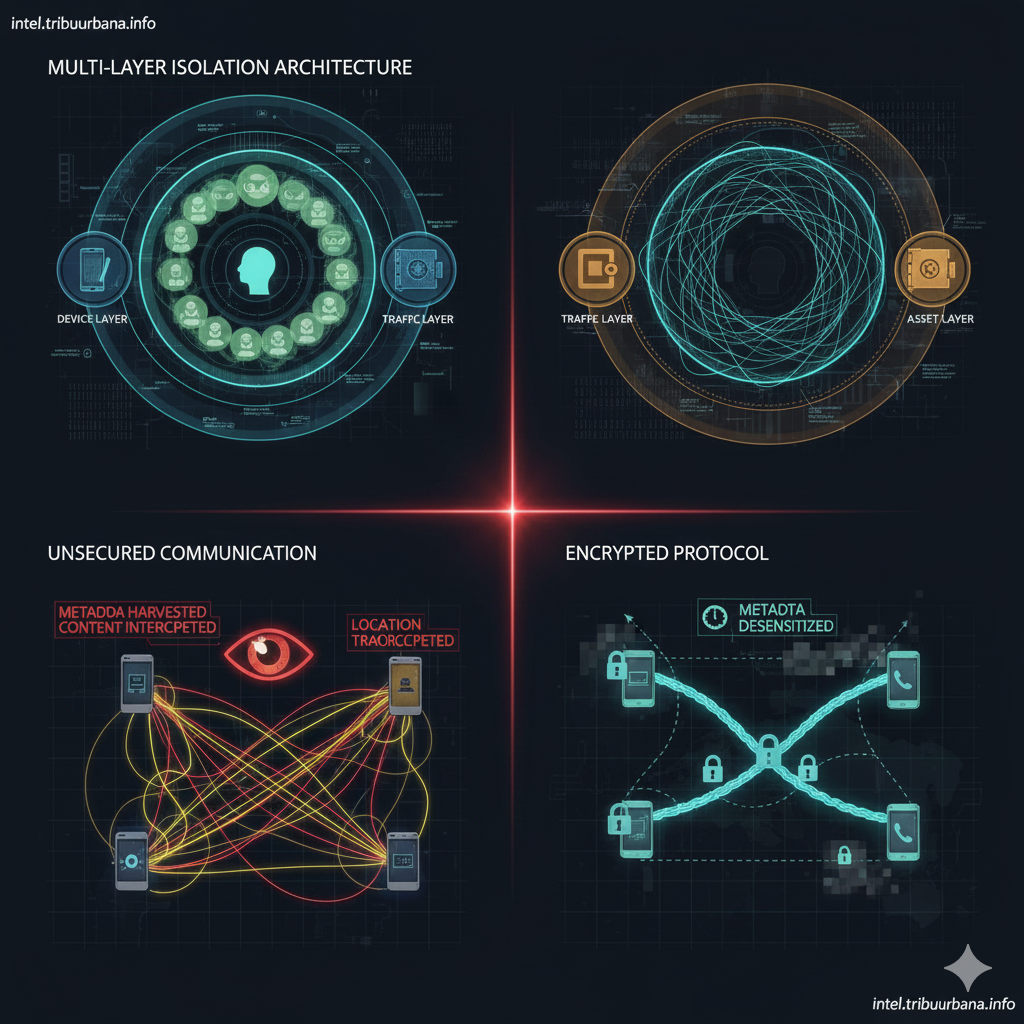
The first tactical maneuver we recommend is a Multi-Layer Isolation Architecture.

Isolation Layer Architectural Logic Primary Objective
Hardware Layer Virtual Machines (VM) or Secondary Devices Separate daily life from core asset management
Identity Layer Alias-based Emails / Burner IDs Decouple real-world identity from activity
Traffic Layer Multi-hop Encrypted Tunnels (VPN/Tor) Mask geographical origin and intent
Asset Layer Non-custodial Hardware Wallets Achieve physical-level ownership segregation

We feel that if you are using the same browser and device for everything, then installing encryption plugins is merely patching a sinking ship with canvas.

2. Communication Sovereignty: Refusing the Intercept

Most popular “instant messaging” apps are essentially data-harvesting factories. In 2026, assuming “encrypted chat” is a default feature is a dangerous oversight.

We prioritize the integration of End-to-End Encryption (E2EE) with Metadata Desensitization. It is insufficient to merely encrypt the content of the message; one must ensure that the “who, when, and where” of your interactions remain obscured. This is why we advocate for decentralized communication protocols—they return server-level permissions to the node operator: you.

3. Systemic Reconfiguration of Productivity Tools

There is a cognitive bias that adopting high-security tools inevitably sacrifices efficiency. We believe the opposite. When your underlying security protocol is stabilized, your productivity becomes remarkably pure. We have observed that tools built on a “Local-First” architecture are significantly more resilient to interference than cloud-synchronized counterparts.

  • Case Analysis: When you utilize decentralized knowledge bases built on Markdown, you are effectively localizing your personal intelligence assets.

  • Data Comparison: Cloud-hosted synchronization averages a 200ms latency with high risk of data leakage, whereas local-first synchronization protocols maintain a ~50ms latency with zero-knowledge, 100% privacy-preserving architecture.

4. Our “Ultimate Tool” Thesis

In this complex digital sprawl, there is no such thing as a “perfect app.” We believe that the real tool isn’t a piece of software you download—the real tool is your operational defense logic.

To navigate this environment, you must implement a Dynamic Defense Mechanism:

  1. Periodic Identity Rotation: Switch your access nodes during sensitive operations.

  2. Zero-Trust Architecture: Assume all platforms are compromised; transmit only the minimum viable data.

  3. Minimalist Configuration: Delete all applications that request excessive permissions without providing critical systemic value.