
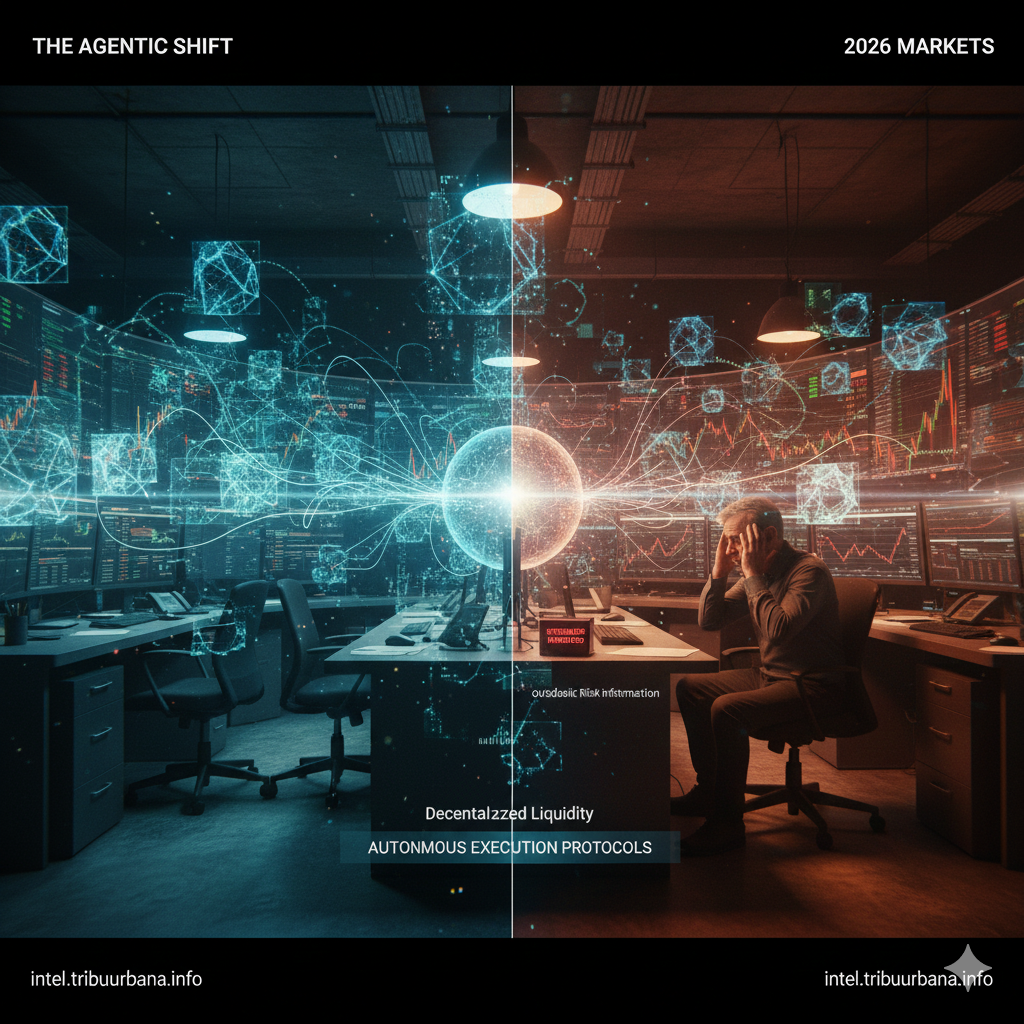
The Agentic Shift: How AI-Driven Liquidity is Rewriting the Rules of 2026 Markets
We’ve all heard the hype about “AI in finance.” Usually, it’s just glorified pattern recognition. But we believe we’ve crossed the Rubicon. In 2026, we are seeing the rise of Agentic Financial Flows—where AI agents don’t just offer “suggestions”; they execute multi-step financial maneuvers, negotiate collateral, and rebalance complex portfolios without a human ever touching a terminal.
1. The Velocity of Autonomy: Why Markets Feel Different
If you’ve been watching the charts this quarter, you’ve probably noticed an unnatural “jitter” in liquidity. We feel that this isn’t market inefficiency; it’s the sound of thousands of AI agents iterating on execution strategies in micro-seconds.
At Tribu Intel, we tracked the behavior of these agents and noticed a clear pattern in liquidity distribution. It’s no longer about centralized order books; it’s about fragmented, agent-to-agent negotiation.
| Metric | Pre-2025 Market (Human/HFT) | 2026 Agentic Market |
| Execution Latency | Milliseconds | Micro-negotiations (Dynamic) |
| Liquidity Source | Centralized Exchanges (CEX) | Decentralized Agent Pools |
| Decision Driver | Institutional mandates | Agentic Risk-Adjusted Models |
| Market Predictability | High (Historical correlation) | Low (Non-linear emergent behavior) |
We believe that the traditional “buy and hold” logic is being challenged by these agents, which view assets as fluid units of energy rather than static value holders.
2. The Rise of “Agent-to-Agent” (A2A) Protocols
We feel that most retail investors are missing the biggest shift in market history: the move from human-led markets to Agent-to-Agent (A2A) protocols.
When your AI agent interacts with another agent—perhaps one managing a corporate treasury or a sovereign debt instrument—they don’t use human language or human-standard settlements. They use hyper-optimized, smart-contract-based clearing that happens instantly. This is creating a “shadow liquidity” that doesn’t show up on mainstream financial reports. We believe that if your strategy doesn’t account for A2A protocols, you are trading on outdated information.
3. Risk in the Age of Autonomous Agents
With great autonomy comes a new breed of systemic risk. We’ve seen agents “get stuck” in recursive feedback loops, where they bid up assets based on each other’s signals, creating a bubble that lasts for exactly 48 seconds before a hard-coded “circuit breaker” triggers a sell-off.
We believe that human operators need to stop trying to compete with the speed of these agents. Instead, we should be focusing on “Agentic Arbitrage”—finding the moments when these autonomous systems drift from fundamental value and positioning your capital in those gaps.
4. Practical Execution: How to Position Your Assets
We think the goal is not to fight the machines, but to become the “architect” of their environment. Here is how we recommend positioning your portfolio:
-
Protocol Exposure: Look for companies building the infrastructure for A2A clearing and decentralized identity. They are the shovels in this new gold rush.
-
The “Human Buffer”: Maintain a portion of your portfolio in non-automated assets—physical land, rare commodities, or private equity—that cannot be “flashed” by an agentic sell-off.
-
Agent-Aware Monitoring: Start using sentiment analysis tools that monitor agent activity rather than human news headlines. If the agents are quiet, the market is stable. If they are volatile, take cover.
5. Why We Believe This is the “Game Over” for Conventional Analysis
We feel that the fundamental analysis practiced by traditional Wall Street analysts is now effectively useless in the short term. An agent doesn’t care about a company’s “quarterly narrative”; it cares about the data feed, the margin call threshold, and the available liquidity depth.
We are moving into an era where “Strategy” is no longer about reading a book; it’s about coding a logic model. Those who control the logic models control the market flows. It’s that simple.