

The Volatility Arbitrage: Positioning Capital When Sentiment Diverges from Reality

The Volatility Arbitrage Positioning Capital When Sentiment Diverges from Reality

The Volatility Arbitrage: Positioning Capital When Sentiment Diverges from Reality

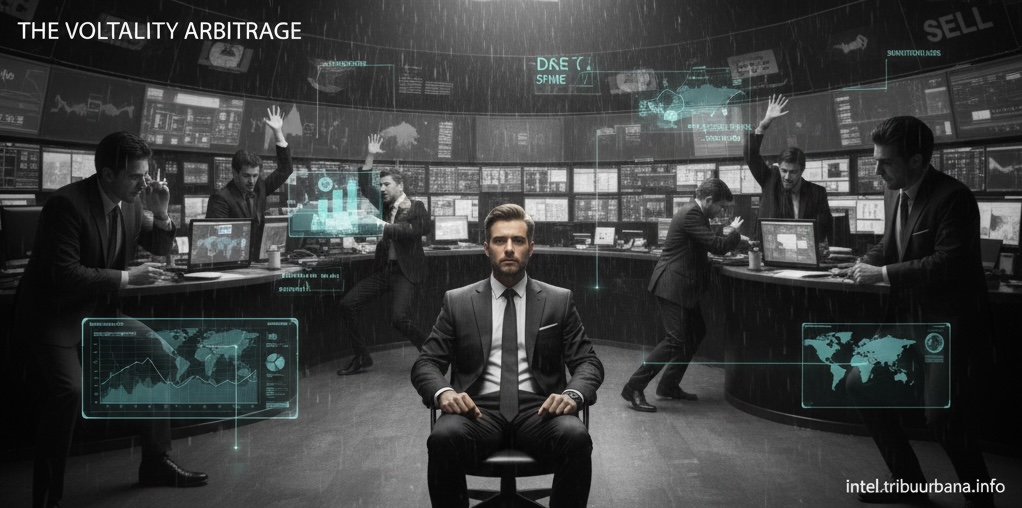
We’ve all seen the cycle: a headline breaks, a panic-sell triggers, and the market drops 3% in minutes. We feel that the average operator’s instinct is to follow the crowd. But at Tribu Intel, we have a different view. We believe that panic is a mechanical process, not a fundamental one. When sentiment diverges from reality, the market stops being a place of logic and starts being a place of arbitrage.

1. The Sentiment-Reality Divergence Matrix

We have developed a framework for mapping sentiment against actual asset performance. When these two metrics move in opposite directions, it is our “Signal to Act.”

Phase Market Sentiment Fundamental Data Tactical Response
Consensus Euphoric/Fearful Stable Stay Neutral/Hold
Divergence (The Gap) Extreme Resilient Accumulate/Arbitrage
Correction Panic/Exhaustion Reverting to Mean Exit/Profit Take

We believe that the “Divergence” phase is where the real wealth is generated. It requires the emotional discipline to buy when the digital noise is at its peak.

2. The Mechanics of Emotional Noise

We feel that “Noise” is the biggest tax on your portfolio. In 2026, social media and AI-driven news loops have weaponized fear. We’ve noticed that most automated systems are now programmed to react to the tone of news, rather than the content of the report.

We believe you can exploit this. If you can build a sentiment-analysis stack that filters out the “emotional tone” and isolates the “factual data,” you gain a distinct advantage. While the algorithms are busy panic-selling, you are positioning yourself at the point of maximum fear, where assets are statistically undervalued relative to their long-term cash flow.

3. Why We Believe “Predictability” is the Enemy

Most operators look for patterns that repeat. We think that’s a trap. We believe that markets are increasingly “Anti-Fragile”—the more you try to model them using past data, the more likely you are to be blindsided by a “Black Swan” event.

We have a different view: Don’t predict. Prepare. Instead of trying to guess what the market will do next week, we structure our portfolio to be profitable regardless of the direction, provided the volatility is high enough. This is the essence of volatility arbitrage. We aren’t betting on the price; we are betting on the chaos.

4. The Operator’s Contrarian Checklist

We think you can maintain your sanity while being a contrarian. Here is how we recommend you handle the next market “melt-down”:

  • The 10% Rule: Never commit more than 10% of your liquidity to a single “divergence” play. The market can remain irrational longer than you can remain solvent.

  • The “Kill Switch”: If the fundamental data changes—not just the sentiment, but the actual balance sheet reality—you must exit. Do not fall in love with a trade.

  • Independent Data Sources: Stop reading mainstream financial news. If the entire market is reading it, it’s already priced in. Look for obscure data—local trade flow, shipping logistics, or private asset surveys.
The Volatility Arbitrage Positioning Capital When Sentiment Diverges from Reality

5. Our Conclusion: Capital is a Tool of Sovereignty

We believe that volatility is just another word for “opportunity in transition.” When the grid gets noisy, most people lose their agency because they lose their emotional control. We feel that by treating the market as a laboratory for testing your own hypotheses rather than a casino for gambling on prices, you become an untouchable actor.

Capital is not just money; it’s a tool. Use it to build a structure that thrives when others are scrambling.

The Agentic Shift: How AI-Driven Liquidity is Rewriting the Rules of 2026 Markets

The Agentic Shift How AI-Driven Liquidity is Rewriting the Rules of 2026 Markets

The Agentic Shift: How AI-Driven Liquidity is Rewriting the Rules of 2026 Markets

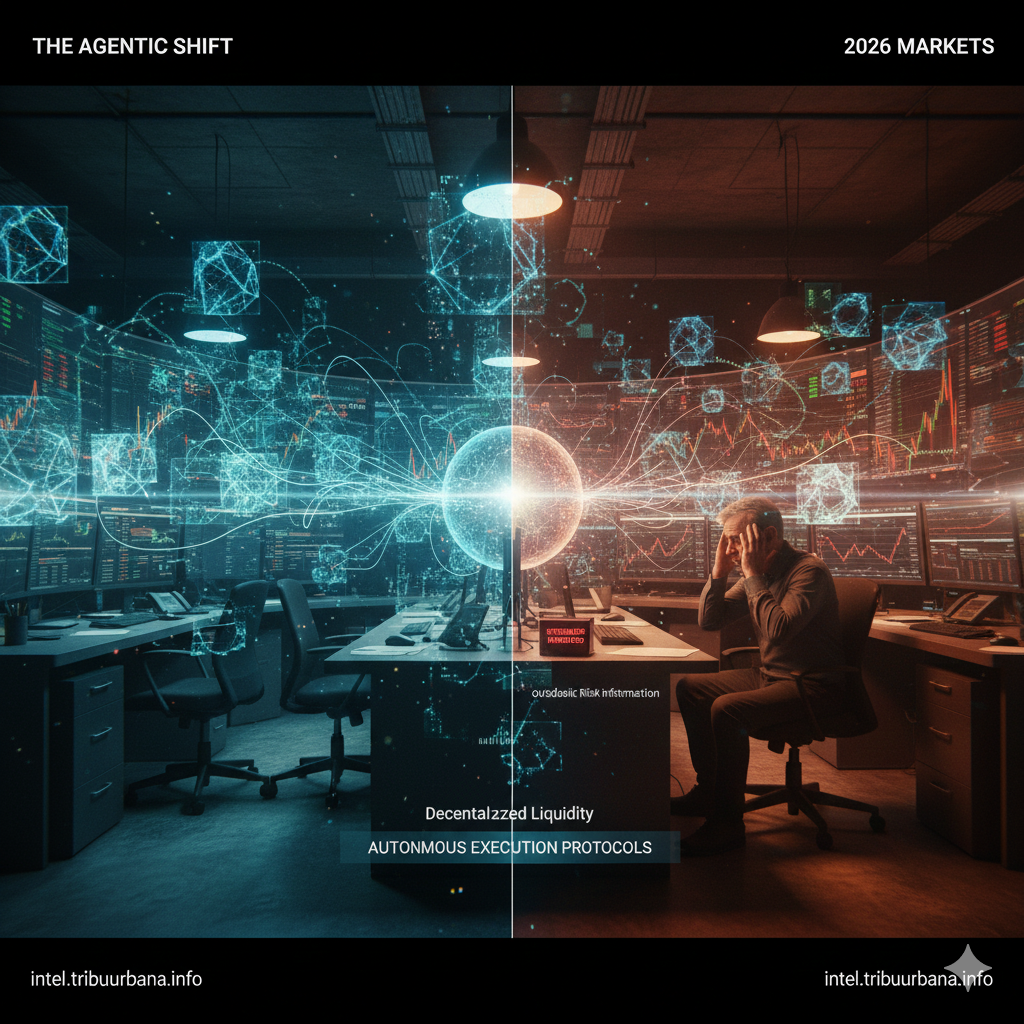
We’ve all heard the hype about “AI in finance.” Usually, it’s just glorified pattern recognition. But we believe we’ve crossed the Rubicon. In 2026, we are seeing the rise of Agentic Financial Flows—where AI agents don’t just offer “suggestions”; they execute multi-step financial maneuvers, negotiate collateral, and rebalance complex portfolios without a human ever touching a terminal.

1. The Velocity of Autonomy: Why Markets Feel Different

If you’ve been watching the charts this quarter, you’ve probably noticed an unnatural “jitter” in liquidity. We feel that this isn’t market inefficiency; it’s the sound of thousands of AI agents iterating on execution strategies in micro-seconds.

At Tribu Intel, we tracked the behavior of these agents and noticed a clear pattern in liquidity distribution. It’s no longer about centralized order books; it’s about fragmented, agent-to-agent negotiation.

Metric Pre-2025 Market (Human/HFT) 2026 Agentic Market
Execution Latency Milliseconds Micro-negotiations (Dynamic)
Liquidity Source Centralized Exchanges (CEX) Decentralized Agent Pools
Decision Driver Institutional mandates Agentic Risk-Adjusted Models
Market Predictability High (Historical correlation) Low (Non-linear emergent behavior)

We believe that the traditional “buy and hold” logic is being challenged by these agents, which view assets as fluid units of energy rather than static value holders.

2. The Rise of “Agent-to-Agent” (A2A) Protocols

We feel that most retail investors are missing the biggest shift in market history: the move from human-led markets to Agent-to-Agent (A2A) protocols.

When your AI agent interacts with another agent—perhaps one managing a corporate treasury or a sovereign debt instrument—they don’t use human language or human-standard settlements. They use hyper-optimized, smart-contract-based clearing that happens instantly. This is creating a “shadow liquidity” that doesn’t show up on mainstream financial reports. We believe that if your strategy doesn’t account for A2A protocols, you are trading on outdated information.

3. Risk in the Age of Autonomous Agents

With great autonomy comes a new breed of systemic risk. We’ve seen agents “get stuck” in recursive feedback loops, where they bid up assets based on each other’s signals, creating a bubble that lasts for exactly 48 seconds before a hard-coded “circuit breaker” triggers a sell-off.

We believe that human operators need to stop trying to compete with the speed of these agents. Instead, we should be focusing on “Agentic Arbitrage”—finding the moments when these autonomous systems drift from fundamental value and positioning your capital in those gaps.

4. Practical Execution: How to Position Your Assets

We think the goal is not to fight the machines, but to become the “architect” of their environment. Here is how we recommend positioning your portfolio:

  1. Protocol Exposure: Look for companies building the infrastructure for A2A clearing and decentralized identity. They are the shovels in this new gold rush.

  2. The “Human Buffer”: Maintain a portion of your portfolio in non-automated assets—physical land, rare commodities, or private equity—that cannot be “flashed” by an agentic sell-off.

  3. Agent-Aware Monitoring: Start using sentiment analysis tools that monitor agent activity rather than human news headlines. If the agents are quiet, the market is stable. If they are volatile, take cover.

5. Why We Believe This is the “Game Over” for Conventional Analysis

We feel that the fundamental analysis practiced by traditional Wall Street analysts is now effectively useless in the short term. An agent doesn’t care about a company’s “quarterly narrative”; it cares about the data feed, the margin call threshold, and the available liquidity depth.

We are moving into an era where “Strategy” is no longer about reading a book; it’s about coding a logic model. Those who control the logic models control the market flows. It’s that simple.

Market Pulse 2026: Why “Digital Sovereignty” is the Ultimate Wealth Moat

Market Pulse 2026 Why Digital Sovereignty is the Ultimate Wealth Moat

Market Pulse 2026: Why “Digital Sovereignty” is the Ultimate Wealth Moat

We believe that current market movements are less about “bulls” or “bears” and more about a violent underlying restructuring.

When you check the news, you see surface-level noise. However, through the Tribu Intel intelligence nodes, we observe a multi-trillion-dollar migration: global capital is shifting from “trusted centers” toward “verifiable protocols.” This is not a marketing slogan; it is an active systemic evolution.

1. The Macro Truth: The Ignored “Entropy”

We notice that most retail investors remain trapped in the growth inertia of 2020-2022. They assume fiat devaluation is temporary, while we view it as an irreversible “systemic loss.”

Below is our intelligence breakdown of core asset comparisons for early 2026:

Asset Class Sovereignty Level Volatility Assessment Tactical Value
Fiat Reserves Low Stable (Nominal) Short-term liquidity only
Digital Assets (BTC/ETH) High Extremely High Long-term value store / Hedge
Private Infrastructure/Equity Medium Medium Cash flow & Capital appreciation
Sovereign Digital Protocols Very High Low-Medium Strategic asset allocation

As illustrated in the table, traditional asset allocation logic has effectively expired in 2026. We believe if you are still relying solely on fiat reserves, you are effectively paying for the “entropy” of the entire system.

2. The Tactical Significance of “Digital Sovereignty”

Why do we emphasize “sovereignty” so heavily? Because in 2026, the true value of an asset does not lie in its face value, but in whether you possess complete control over that asset.

We have observed that many emerging Fintech tools are not just providing convenience; they are redefining “wealth ownership.” If the asset you hold requires complex external authorization to move, it is functionally a debt—not an asset.

3. Our Recommendation: Building an Anti-Fragile System

We believe that to survive and profit in this era, you must possess cognitive clarity across three dimensions:

  • Isolation Strategy: Stop exposing your digital assets to single custodial platforms.

  • Protocol-Oriented: Learn to identify financial protocols that feature “censorship resistance.”

  • Signal Filtering: If a headline is in the top ten of Twitter/X trends, it has likely already exhausted its Alpha.