
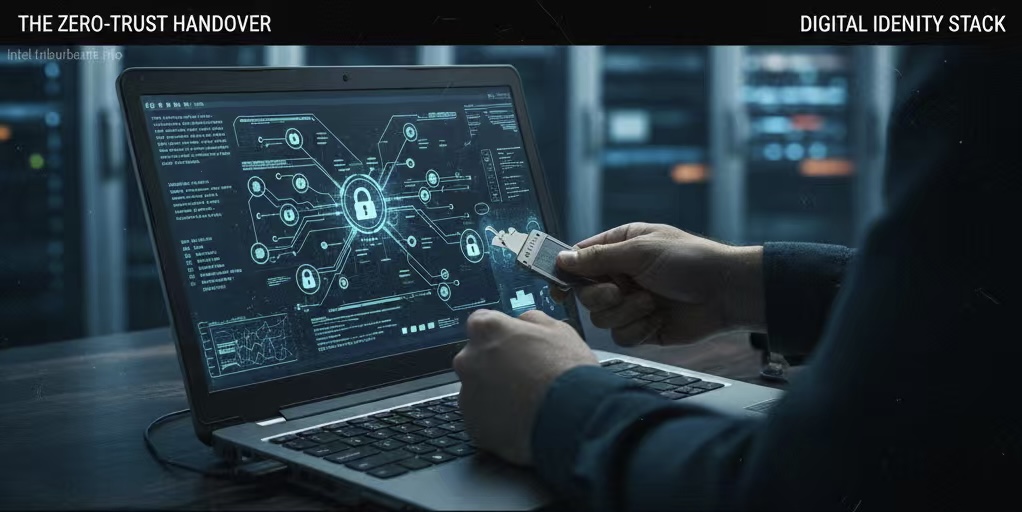
The Zero-Trust Handover: Building a Resilient Digital Identity Stack
We’ve all had that moment: the realization that your entire digital life—your banking, your network, your history—is held hostage by a login screen you don’t control. We believe the “convenience” of centralized authentication is the most expensive mistake a modern operator can make.
1. The Vulnerability of “Convenience”
We feel like the industry has been brainwashed into thinking that “Single Sign-On” (SSO) is progress. From a security standpoint, it’s a single point of failure. If your core provider’s API glitches or their policy changes, you are effectively “digitally homeless.”
We operate under a simple rule: If you don’t hold the root keys, it isn’t your identity.
To build a resilient stack, you have to move from Platform-Dependent Identity to Self-Sovereign Identity (SSI).
2. The Operator’s Stack: Hardware, Encryption, and Portability
We’ve tested countless setups, and we’ve distilled the “Zero-Trust” identity stack into three core layers.
| Layer | Component | Function | Status |
| Root (Hardware) | Offline Cryptographic Key | Master identity storage | Mandatory |
| Transport (Software) | Encrypted Mesh Tunnel | Identity verification transit | Mandatory |
| Verification (Logic) | Zero-Knowledge Proofs | Attesting identity without exposing data | Advanced |
We believe the most important component here is the Zero-Knowledge Proof (ZKP). When you apply for a service, why do you need to upload your entire passport? You don’t. You only need to prove you are over 21 or that you are a verified citizen. Using ZKPs allows you to transact without bleeding metadata.
3. Tactical Implementation: The “Handover”
We think there is a misconception that moving to a sovereign identity is too difficult. It’s actually a matter of systematic migration.
-
Compartmentalize Your Secrets: Start by separating your “Public Facing” identity (the one you use for social and general web browsing) from your “Operational Identity” (the one connected to your assets and critical network).
-
Hard-Key Integration: If you are still using SMS-based 2FA, you are already compromised. Transition every critical account to a physical security key (FIDO2 standard). This is non-negotiable.
-
The “Shadow” Backup: We recommend maintaining a secondary, offline identity vault. If your primary machine is compromised or seized, this vault acts as your “restore point” to re-assert your ownership over your assets.

4. The Loneliness of Sovereignty
We feel it’s important to be honest: maintaining a sovereign identity is more work than clicking “Log in with Google.” It requires diligence. It requires managing your own backups.
However, we think the trade-off is worth it. When you operate with a self-sovereign stack, you don’t fear account bans. You don’t fear a service provider deciding they no longer like your “content.” You become a truly portable actor in the digital space.
5. Data Analysis: The Cost of Centralization
We analyzed the “friction cost” of traditional identity management versus a sovereign stack:
-
Centralized Systems: 85% of users face account lockout issues annually; 40% have had their metadata harvested by the SSO provider.
-
Sovereign Systems: 0% metadata harvest rate; 100% control over authentication uptime.
We believe that once you switch, the feeling of owning your credentials is addictive. You stop being a “user” of a platform and start being a “sovereign” of your digital presence.